


Muarpion and Roarpion: Rock moves, Shadow defence and a Nature orb
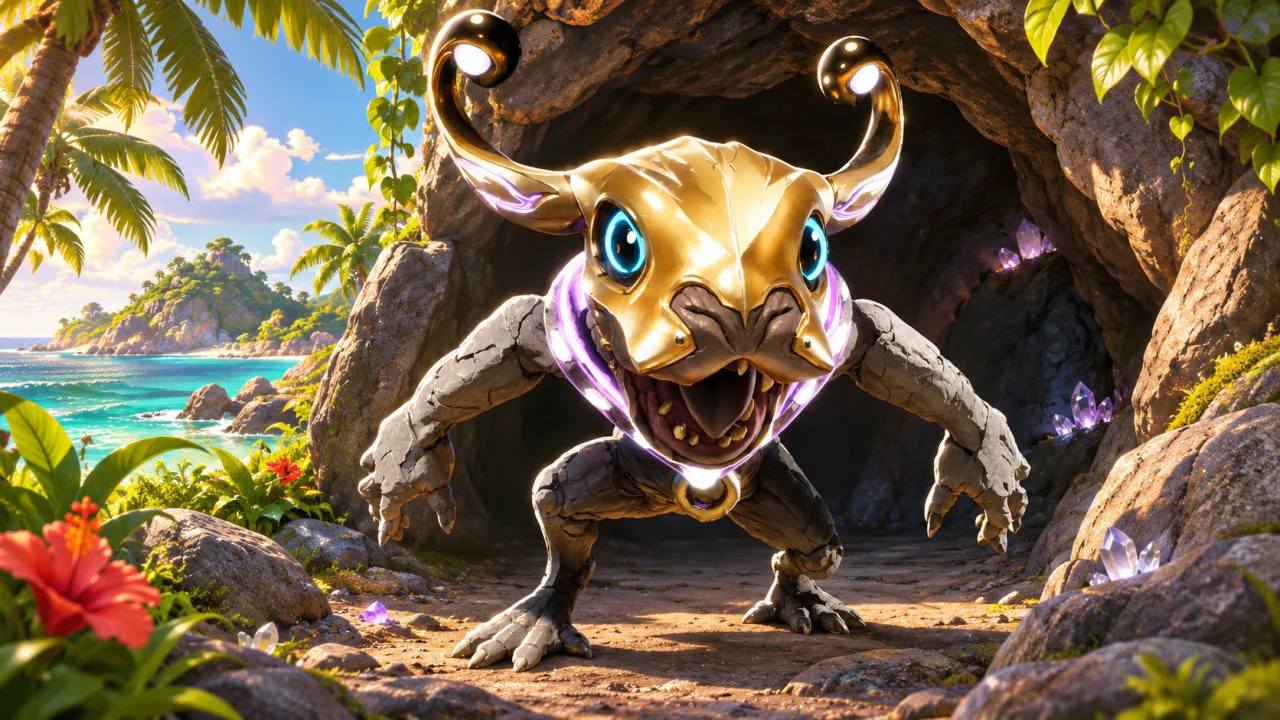
Muarpion evolves into Roarpion through the level-25 requirement and one Nature orb listed in the public Matebook. Both forms use Rock moves, while Roarpion adds Shadow to its defensive elements. Check those fields separately: the required orb is not something to infer from the creature’s Rock label.
The reference checked on 22 November 2026 lists Muarpion as Common and Roarpion as Rare. This guide compares that family’s current public data. It does not turn habitat entries into guaranteed encounters or base values into a ranking of owned companions.
What stays the same across the family?
The Matebook places Muarpion and Roarpion in a two-form family. Both have Rock as their primary element and Rock dig as the listed escape ability.
Their move entries also remain Rock. That does not make the two forms identical. It simply means the family’s new secondary defensive element should not be mistaken for a change to every attack.
A useful first comparison is the exact form name, element badges and move names. Looking only at a silhouette or a broad element colour leaves out several of the fields that actually change.
Why does the evolution entry say Nature orb?
Muarpion’s current evolution record names one Nature orb alongside level 25. That is the requirement the public card displays. This article reports it rather than substituting a Rock orb based on the creature’s primary element.
The evolution readiness guide explains the separate level and item checks. Use the actual card and the installed game’s evolution prompt together when preparing an evolution.
If a later build presents a different requirement, record the version and the exact discrepancy. A useful report identifies both values. It does not silently assume the website or the game must be right merely because one matches an intuitive rule.
Which moves should you compare?
Muarpion lists Rock Punch at level 1, Rock Throw at level 10, Ground Shake at level 30 and Rock Storm at level 70. Their roles are melee, projectile, area and special.
Roarpion lists Stone Slam, Crippling Throw, Earthquake and Seismic Burst Ranged at the corresponding unlock levels. Those names belong to Roarpion’s record; do not use Muarpion’s move name when discussing the evolved form.
The unlock list describes progression. It does not mean a newly obtained creature has every entry available. Read the current level and equipped or available moves before planning around the level-70 special.
For a broader explanation of move elements and defence, see the element matchup guide. The distinction matters particularly when a second element appears on a later form.
How does Shadow change the defensive comparison?
Muarpion’s reviewed record lists Psychic and Water weaknesses at 2, plus Electric and Ice resistances at 0.5. Roarpion’s record instead lists Fire and Water weaknesses at 2, with Ice resistance at 0.5.
That changes the question you ask before an encounter. In a labelled model comparison, an Electric attacker and a Fire attacker do not have the same defensive relationship with both forms. Check the target form’s combined record rather than carrying the first form’s resistances forward.
These are reference multipliers, not a damage prediction for a named enemy. Other details of the actual encounter still matter. Adding Shadow also does not establish that a Shadow attack appears in the listed move set.
What do the base numbers show?
Muarpion’s base total is 313. Its listed values are 86 Hit points, 46 Damage, 48 Attack power, 97 Toughness and 36 Haste.
Roarpion’s base total is 415, with 119 Hit points, 69 Damage, 69 Attack power, 119 Toughness and 39 Haste. The increases are not identical across fields, so the total alone hides the shape of the comparison.
These are public base values. They are not measurements from two owned creatures with matched level and progression. Our base-total explanation helps keep that reference layer separate from a creature’s current state.
Where does the reference place them?
Both reviewed records are marked as found in the wild. Muarpion lists Nature and Open zones, while Roarpion lists Ice and Open zones.
Those categories help frame a search, but they are not a promise that a particular creature will appear at the next bend. The records also contain level bands and region associations. Treat them as reference conditions, not a fixed spawn timer or a guaranteed route.
The descriptive text’s mention of caves and minerals is flavour context. It should not replace the actual Where found fields when you are trying to understand availability.
FAQ
Does Roarpion use Shadow moves in this reference?
Its reviewed move entries are Rock. Shadow appears in the defensive element combination.
Should I collect a Rock orb for Muarpion because it is Rock?
The reviewed evolution entry specifically names one Nature orb. Check the actual requirement rather than inferring it.
Does a larger base total decide which companion I should use?
It supports a comparison, but it does not replace current level, moves and the task you want to complete.
Sources and next step
Primary evidence is the public Muarpion card, Roarpion card and species dataset, checked on the date above. Explore the family, then use the gameplay guide to plan your next session.