

AneeMate beacons and map: plan a route with a return
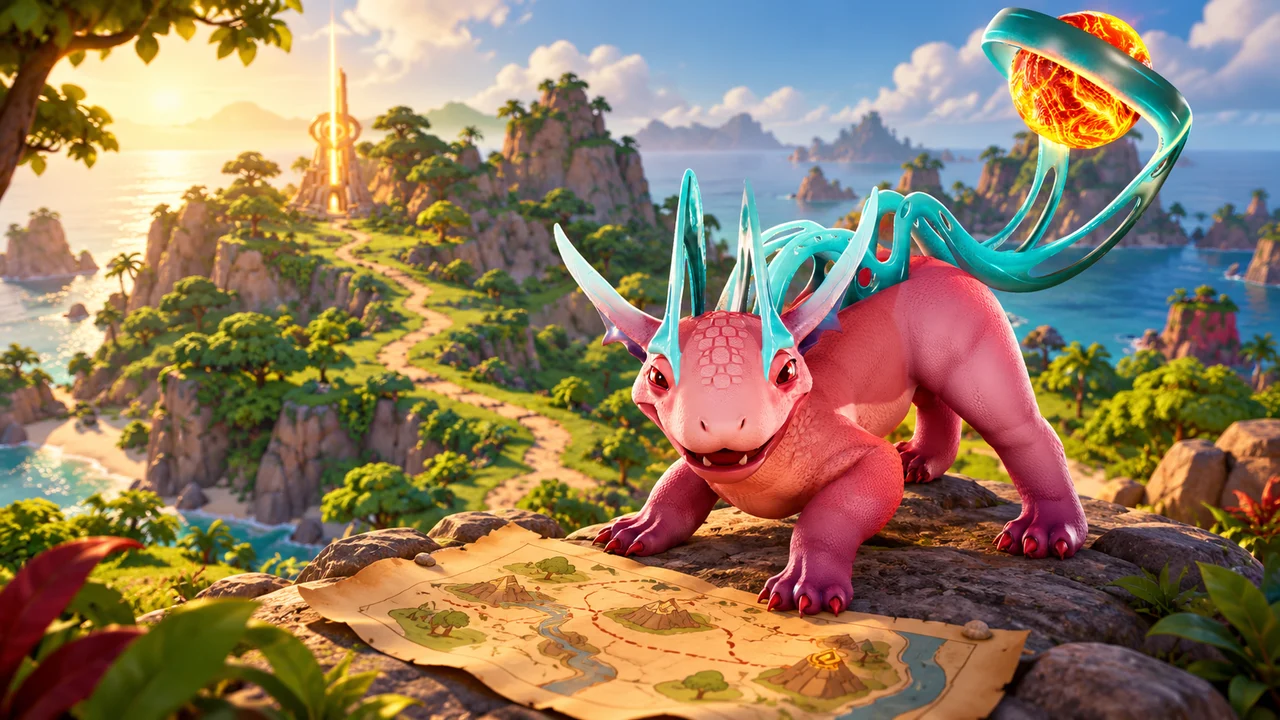
AneeMate's published guide describes beacons as landmarks you light, then use to travel between activated beacons or home. The map tracks places, people, quests and home, while walking clears unexplored cloud. A useful route therefore has both an outward objective and a realistic way back through the locations you have actually discovered.
A marker can suggest a destination without telling the whole story of reaching it. A beacon can make a later journey simpler without revealing all the ground between two places. Thinking about those as different jobs helps turn a wandering session into a route you can understand and repeat.
This article interprets the official exploration guide, checked on 22 October 2026. It is based on published documentation, not a hands-on verification of every feature in a released game build. Use the instructions and availability shown in your installed version.
Separate destination, discovery and travel
Three questions are easy to collapse into one: Where do I want to go? Which ground have I explored? Which travel points are active? Keeping them separate avoids a common planning mistake: assuming that seeing a place name means having a direct journey to it.
The guide describes lighting a beacon when you reach it, and travelling from a lit beacon to another lit one or home. That establishes activation as a meaningful step. It does not establish that every visible landmark is already usable, or that you can teleport from any point in the world.
The map has a different role. It helps you understand your position and the information available about the island. Start there when a route feels confusing rather than treating the closest-looking marker as an instruction to run in a straight line.
Use the map to answer one question at a time
The published map description includes marker categories and a way to locate yourself. It also describes cloud clearing permanently over ground you walk. These are tools for building a clearer picture of a journey, not a guarantee that every route is open.
Try a simple planning question: “What is my next useful stop?” That might mean a quest location, a landmark you want to reach or the return home. Looking at everything at once can obscure that small decision.
An original planning example: a player wants to explore beyond familiar ground but has little time for the session. They choose one landmark as their objective, note their current position and decide that reaching it is enough. They do not add several unseen destinations just because more markers are visible.
This is a suggested way to organise attention, not a timed route or a promise about the distance between locations.
Activate a beacon before planning around it
AneeMate's guide lists Hopesgarden, Nature Landing, Vanguard Drop Site, Hopesfalls, Solomori Falls, Ice Gate, Ice Vault and Ice Lake among its beacon locations. It describes the first beacon as active from the start.
The names are useful orientation points, but they should not become an invented optimal order. This article has not tested a fastest route through them, and the list alone does not establish travel costs, encounter difficulty or the right destination for your level.
When reaching a new beacon, read its interaction and destination options. Then update your plan using the state actually shown. “I have reached this landmark” and “this is now an available travel connection” should be confirmed rather than casually treated as identical.
For wider preparation before leaving camp, see our home and building guide.
Plan the return before adding another detour
Consider a second fictional example. A player sets out to investigate one new landmark. Along the way, another attractive area comes into view. Instead of automatically extending the expedition, they pause to ask where the nearest known return connection is and whether the original objective is complete.
They might continue. They might also return home and explore the second area next time. Both are coherent choices. A route does not become a failure because it leaves something unexplored.
The useful habit is choosing the detour consciously. An exploratory journey and a direct supply trip can follow different priorities. There is no need to turn every outing into a maximum-distance challenge, especially when your own session time is the scarce resource.
Read our party objective guide if the next destination also changes which companions you want to bring.
A map does not remove environmental questions
The exploration guide describes element-dependent passages as well as beacons and map functions. That matters because navigation has more than one layer: identifying a destination is different from understanding an obstacle on the way.
Do not infer a missing map feature every time a direct path is unavailable. Read the encounter and passage information the game provides. Equally, do not claim that owning a specific creature guarantees access to an entire region without checking the actual requirement.
If you are preparing an outing around a creature's element, our element matchups guide provides additional context. Combat matchups and passage requirements remain distinct questions; one should not be substituted for the other.
Make route notes useful for your next session
A short personal note can be more helpful than a long checklist: your next objective, the landmark last reached and the question still unresolved. This is an optional planning habit, not a feature claim about automatic journals or custom map annotations.
For example: “Reached the landmark; next time check the passage nearby.” That leaves a clear starting point without pretending you completed a route you only intended to take. If sharing a community tip, distinguish a route you actually tested from one you are suggesting.
Common questions
Can I travel to every beacon immediately?
The guide describes travel between lit beacons and says you activate additional beacons when reaching them. It does not support treating the entire network as unlocked immediately.
Does clearing map cloud mean every obstacle is gone?
No such rule is established by the map description. Revealing ground and meeting passage requirements are separate matters.
Is this the fastest route across the island?
No. It is a planning framework based on documented mechanics, without measured travel times or a verified optimal sequence.
Choose one destination, confirm your available connections and leave room for discovery. The complete player guide is the place to check the documented controls and current explanations before your next route.